
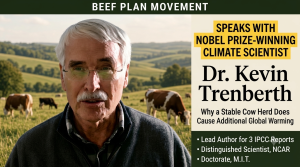
The Beef Plan Movement recently hosted an in-depth scientific exchange with world-renowned climate scientist Dr. Kevin Trenberth. Holding a doctorate in meteorology from the Massachusetts Institute of Technology (MIT), Dr. Trenberth is a former Lead Author for the Intergovernmental Panel on Climate Change (IPCC) across its 1995, 2001, and 2007 assessment reports. His pioneering work in atmospheric physics and Earth energy budgets earned him a shared 2007 Nobel Peace Prize alongside his IPCC colleagues.
Speaking from the pinnacle of global climate science, Dr. Trenberth offered a powerful validation of pasture-based beef production, directly challenging popular misconceptions and calling for immediate reforms in international policy.
During the discussion, Dr. Trenberth focused heavily on the flawed metrics currently used to measure agricultural emissions, pointing out that “GWP100 is not a good metric for measuring short-term gases.” He explained that treating all greenhouse gases identically distorts real-world physics, noting that policy must “discriminate between biogenic and fossil methane, because methane is a short-lived gas. As long as the number of cattle is stable, the methane is decaying as fast as it is being put into the atmosphere.” Addressing global emissions trends, he clarified that “most of methane emissions are from the tropics associated with wetlands and deforestation,” adding that “the issue is methane is increasing, which is from the tropics; most increases are from wetlands.”
Reaffirming the societal value of livestock systems, Dr. Trenberth stated that “growing beef animals to produce food is a huge benefit.” On the carbon dynamics of grazing herds, he highlighted that “one beef animal takes up around 25kg per year of carbon, which is equivalent to 3.7 trees.”
In contrast, he cautioned against over-relying on forestry as a permanent fix for industrial pollution, clarifying that “trees are not the solution as a tree has a typical lifespan of 35 years, whereas CO2 stays in the atmosphere for hundreds of years.” Dr. Trenberth expressed strong criticism of the public narrative surrounding agriculture, pointing out that regarding the “focus on cows in the media, mostly it’s rhetoric from the very powerful fossil fuel companies. The biggest problem is emissions of CO2 from the burning of fossil fuels.” He described this misleading “media coverage as frustrating and much the same in New Zealand.”
When asked directly if academic consensus is divided on livestock—specifically responding to the exchange with Beef Plan Movement Chairman Eamon Corley (” Is there one group of scientists who think cows are a problem and one group who think they aren’t?”), Dr. Trenberth set the record straight: “Scientists are not the problem. The problem is environmental groups who have seized upon the problem, and I think they are incredibly uninformed.”
This disconnect between sound science and climate policy has had global consequences. Dr. Trenberth noted that “in the Paris Agreement, governments reacted by putting pledges in place that were often not well science-based,” leading to a situation where “governments made policies that were misguided as they were based on GWP.”
To resolve these distortions, Dr. Trenberth outlined two mandatory reforms for the international scientific community: “Two advancements need to be made in the IPCC: to distinguish short-lived gases like methane from long-lived gases like nitrous oxide and CO2, and to distinguish biogenic methane, which is circular, from fossil methane.”
The Beef Plan Movement welcomes Dr. Trenberth’s scientific clarity. His insights confirm what livestock farmers have maintained: stable, pasture-based cattle production operating within a biological cycle is not the driver of additional climate warming. It is time for national and global policy to align with rigorous science, ending the unfair focus on sustainable agriculture and concentrating efforts on burning fossil fuels.