Bord Bia’s stated mission is to “drive the commercial success of a world-class Irish food, drink, and horticulture industry through market insight and partnership. Its core purpose is to bring Ireland’s food and drink to the world, enabling the growth and sustainability of producers, and ensuring Irish food is synonymous with quality and sustainability.“
There is no arguing that Ireland’s food, drink and horticulture industry is fantastically commercially successful. There is also no arguing that it has not been the Irish farmers, regardless of sector, that have seen the most financial benefit. Indeed, many farming sectors are on their knees and in a state of decline while many of the companies that process and sell their produce are announcing millions in profit. This is indicative of a serious systemic problem that is not adequately compensating the farmers and growers for their produce.
Producing high quality food is expensive and it has been through the investment and labour of farmers over decades that have rightly established a global reputation for high-quality, in-demand Irish food. So why aren’t farmers profiting?
The remit of Bord Bia is to drive ‘commercial success’ and in this context, that means that the people seeing the most immediate benefit are the companies like those that sit on the board – those that sell the end product. In order for that system to work for the benefit of farmers and producers too, those profits would need to result in farmers and growers being paid cost-of-production plus a reasonable profit for what they produce. But that isn’t happening.
To understand why, we can look at one small part of the ecosystem that seems to reward processors and producers more than farmers and growers – the Bord Bia Marketing Assistance Payments.
The Bord Bia website states: “Bord Bia’s Marketing Assistance Programme (MAP) Grant helps Irish food, drink and horticulture producers enhance their performance and gain a foothold in new markets by providing financial support for a range of marketing activities.
For 2025 applicants, the grant is open to producers who are client companies of Bord Bia who have a turnover greater than €100,000 but less than €3.5 million. Producers and client companies should be actively participating in the Origin Green Programme or a relevant Quality Assurance & Sustainability Scheme, with an up to date Annual Review Status at 31 December 2024.“
Bord Bia is funded through levies by by Irish livestock farmers, levies from dairy co-ops, Irish taxpayers and EU taxpayers. Notably absent from the eligibility conditions is the requirement that you should be using ingredients from Irish farmers and growers to qualify. Understandably, there may be a need for some ingredients from other countries but surely there should be some minimum amount of Irish produce needed to qualify? Why would Irish livestock farmers, dairy co-ops and the taxpayer have any interest in supporting producers to import ingredients and sell them internationally when the remit is the promotion of Irish food?
And surely if processors and producers are making money from food and drink from Irish growers and farmers and being supported in doing so by the taxpayer, they should be required to pay above cost-of-production to the farmer for the quality assured ingredients?
The second question then arises about the context in which companies are selected for support.
The annual accounts produced by Bord Bia state under ‘disclosure of transactions’: “In the normal course of business the Board may approve grants and may also enter into other contractual arrangements with undertakings in which Bord Bia Board Members are employed or otherwise interested. The Board adopted procedures in accordance with the guidelines issued by the Department of Public Expenditure and Reform in relation to the disclosure of interests by Board Members and these procedures have been adhered to by the Board during the year. No grants were approved or paid during the year to companies with which Board Members are associated.”
Annual accounts from 2015 to the most recent year 2024, are published and publicly available on the Bord Bia website. In the 2024 annual accounts it states: “In terms of payments, grants totalling €823,128 were paid to 94 companies during the year, The list of companies in receipt of grant payments is noted at the end of this report.” However, the list of companies that received assistance appears to be missing in the 2024 report.
Caroline Keeling, CEO of the well-known Keelings Fruit Growers/Importers, has unsurprisingly served on the board of Bord Bia over the past decade – 2015, 2016, 2017, 2018 & 2019 (term ended on the 10th December 2019). The Keelings website states that they farm over 3,000 hectares across Ireland, Costa Rica and Brazil and source fruit from 46 countries and supply over 1,000 customers across 30 countries worldwide. This seems fair enough as Ireland is not known for its ability to produce bananas and pineapples, for example!
The Keelings company is a family affair. Fred Keeling grew up on the Keeling family fruit farm in North Co. Dublin. In 2005, he branched off from the parent company to be Managing Director of Keeling F Juices, along with his son, John. The relationship between Fred Keeling and Caroline Keeling is not immediately confirmable but appears to be uncle and niece – this awaits clarification.
Fruitnet reports that restructuring of the Keeling group cost more than €30 million and saw Fred retire from his position: “The deal sees Frederick Keeling step down from his position with the company to be replaced by his nephew David, the son of Joe Keeling, who remains in place as chief executive.” They note that Fred and his 3 sons received €19.1 million for their shares in the family’s holding company Borling Investments. It is also noted that a ‘certain payment’ was made to Fred in respect of his employment with the company ending and his pension was brought up to maximum funding limits.
We have no visibility on what Bord Bia marketing assistance payments may or may not have been received between 2005 and 2014 as those accounts are not available on the Bord Bia website. Nor can we see the list for 2024. What we do know is that in the 9 years between 2015 and 2023, Keeling F Juices received 7 Marketing Assistance Payments from Bord Bia totalling €108,000:
2015 report – €5,000
2016 report – €17,000
2017 report – €0
2018 report- €0
2019 report – €40,000
2020 report – €15,000
2021 report – €9,000
2022 report – €10,000
2023 report – €12,000
For all of these years, the annual accounts states: “No grants were approved or paid during the year to companies with which Board Members are associated.”
It’s critically important to state that none of the foregoing necessarily constitutes any wrongdoing on behalf of either Keelings Fruit Growers/Importers or Keeling F Juices. For the ordinary, everyday person, there is definitely an ‘association’ between these two companies. But the word ‘associated’ in this context has a strict legal meaning and it may well be that the relationship between Keelings Fruit Growers/Importers and Keeling F Juices is sufficiently distant that technically there is no legal ‘association’ between them.
But there are still some questions to ask in terms of ‘association’ in this context:
Firstly, from where do the Keeling F Juices company source the fruit with which they make the juice? If the sole source of their fruit is Keeling Fruit Growers/Importers then that might be indicative of a closer association, with both companies controlled by the same group of people – the Keeling family. If there is no longer any relationship between them, then they might not meet the requirement for ‘associated’ at all.
And secondly, how much of the Keeling F Juices range is comprised of Irish grown produce?
The fruit juice world is seasonal and I am conscious that we are looking at the website in January of 2026 where the range might be substantially reduced from that available during the summer months for example. Nonetheless, the range available currently is predominantly made up of what can only be credibly be considered international fruits:
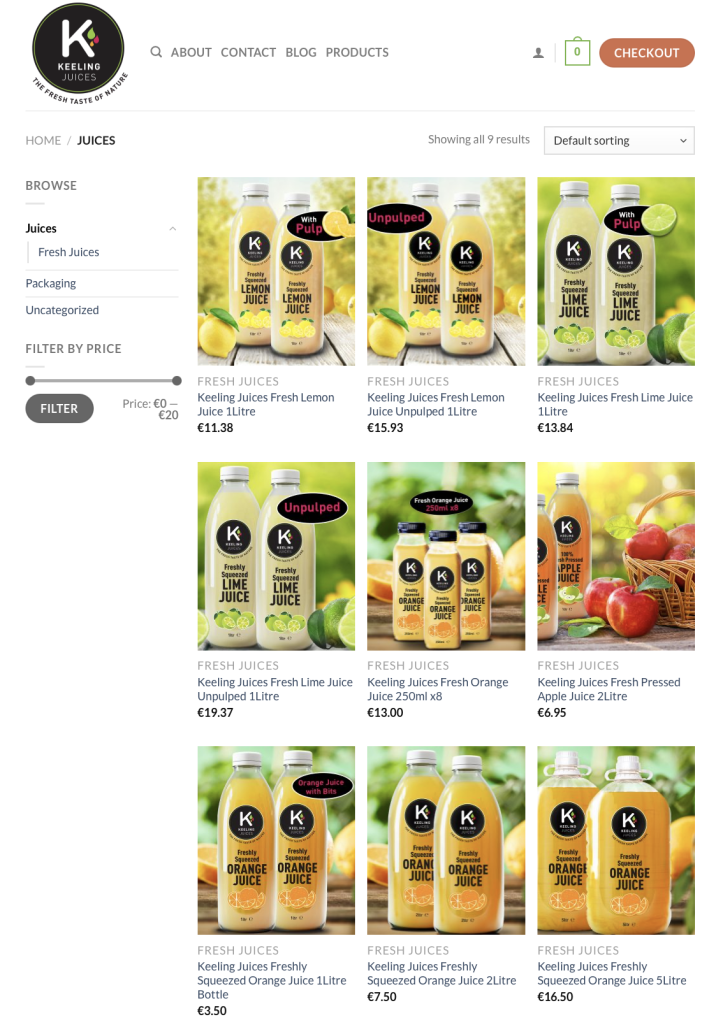
Only in the case of the single apple juice product is it possible that Irish produce is used. The Keelings family farm states that they now grow over 4 million apples annually. It is not known if Fred Keeling obtains his apples exclusively from Irish growers other than Keelings fruit farms – and perhaps he does!
But if he purchases apples directly and solely from Keelings family farm, then the Irish farmers and taxpayers who fund Bord Bia have paid at least €108,000 in marketing assistance to a company whose produce is primarily not grown in Ireland and is only of benefit to one Irish grower – the multi-million company Keelings – whose CEO sat on the board of Bord Bia for some of those years.
It may well be that, technically, no rules are broken and that this is considered perfectly acceptable to the board of Bord Bia and the Irish Government members who have spoken in strong support of the Chair importing Brazilian beef which does not meet the standards that Bord Bia imposes on Irish farmers.
But it is enraging nonetheless, both to Irish farmers and the Irish taxpayer struggling to meet rising costs of living. Again, to be clear, this is not an issue with either of the Keelings companies. It is an issue with the structure and governance of Bord Bia and the manner it which provides supports and to whom.
Because even if technically legal, it is morally dubious and certainly does not meet the remit of the mission statement. It is unclear how much Irish reared or grown produce is even being promoted in these grants. And Bord Bia, as a State body needs to look to their own standards. Irish livestock farmers are producing the best beef in the world to the highest standards. Surely our State body can be asked to achieve better than ‘technically legal’ or ‘didn’t break any rules’?
Bord Bia is a very valuable institution, providing an essential service to farmers and growers at home and internationally. The standards they hold for those farmers and growers are welcome and needed. But we need to hold them to a standard too. We need greater representation from the farming and growing community on the board as clearly, corporate interests are being served better than those of the farmers.
We need clearer guidelines on eligibility for grants and assistance to ensure that only companies who primarily support Irish farmers and growers in a financially viable way are funded by the taxpayer. Perhaps we should consider whether a ‘needs assessment’ should be conducted to avoid providing funding to companies who can and should easily pay for services themselves – not suggesting that this is the case here.
Horticultural grower numbers are shrinking. Suckler beef farm numbers are shrinking. The primary reason for that (and for the issues with generational renewal) is that it is getting harder and harder to make a living doing it.
So if we live in a world where Bord Bia is fantastically successful and the companies who make money from what farmers and growers produce are fantastically successful and the farmers and growers they are buying from are slowly going out of business because they can’t make a living from it, then we have a fundamental structural problem in our systems that we are not addressing.